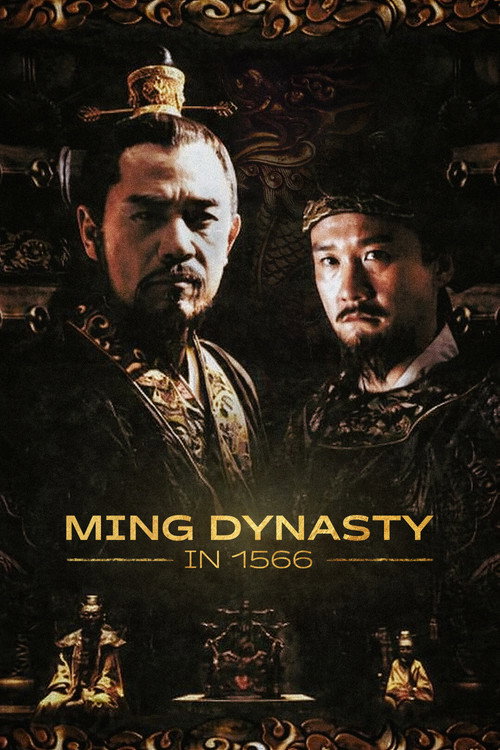
Ming Dynasty in 1566 (大明王朝1566)
Plot Overview
Set during the 39th year of the Jiajing Emperor's reign (1566 AD), the Ming Dynasty is plagued by rampant corruption and widespread misery. After 20 years of secluding himself in the Western Garden to pursue Taoist alchemy, the paranoid yet brilliant Emperor Jiajing (Chen Baoguo) controls the empire from behind a screen. When a severe financial crisis hits the imperial court, the powerful Grand Secretary Yan Song (Ni Dahong) proposes the "Convert Farmland to Mulberry Fields" policy—a scheme ostensibly designed to produce silk for export but in reality, a thinly veiled plan for massive land annexation [10†L18-L19]. What follows is a brutal, high-stakes power struggle involving four factions: the Jiajing Emperor, the ruthless Yan clique, the reform-minded Qingliu (Purist) faction led by Crown Prince Yu, and the cunning Directorate of Ceremonial Affairs (eunuchs). As Yan Song's son Yan Shifan orders the deliberate breaching of dikes to flood thousands of acres and force farmers off their land, a low-ranking county magistrate named Hai Rui (Huang Zhizhong)—renowned as a "straight arrow" for his fearless integrity—is dispatched to investigate [10†L19-L21]. The story builds toward an explosive final confrontation, where Hai Rui directly challenges not only the corrupt minister but the emperor himself in his famous "Memorial for Universal Security," questioning the very legitimacy of monarchical rule.
Main Cast



Deep Dive: Story Arcs & Episode Guide
- The 46-episode series (45 minutes each) can be broadly divided into four main story arcs:
- Act 1: The Birth of a Doomed Policy (Episodes 1-10): Following the execution of an honest official who dared to speak out, the corrupt Grand Secretary Yan Song proposes the "Convert Farmland to Mulberry Fields" policy to alleviate the fiscal crisis [7†L2-L17]. Meanwhile, Crown Prince Yu's wife gives birth to the Emperor's first grandson, which alters the power balance in the court. When the inflexible Commissioner of the Ministry of Revenue, Hai Rui, obstructs the land-conversion scheme, he is dispatched from the capital to serve as the magistrate of a poor county in Zhejiang, placing him in the direct path of the coming storm. This arc establishes the key players and sets the fateful policy in motion.
- Act 2: The Scandalous Flood & Escalating Conflict (Episodes 11-20): To accelerate the acquisition of cheap land, Yan Shifan orders the destruction of river dikes, deliberately flooding nine counties and displacing hundreds of thousands of farmers. Faced with the horrific consequences of "man-made natural disaster," Hai Rui must decide whether to follow orders or protect the starving populace. The Qingliu faction seizes upon the flood as the perfect opportunity to initiate the "Down with Yan" campaign [10†L18-L21].
- Act 3: The Collapse of the Yan Clique & Its Aftermath (Episodes 21-35): The investigation intensifies in Zhejiang. The Emperor Jiajing, deeply involved in the corrupt system he created, must decide whether to protect the man who manages his finances or sacrifice him to appease the public. When the Emperor turns his back on Yan Song, the entire corrupt clique unravels. However, the arc concludes on a profoundly ironic note: after the Yan faction is eliminated, the fundamental problems remain. The treasury is still depleted, corruption persists, and the Emperor's Taoist retreats continue unchecked — exposing the truth that the rot lies not in a single minister but in the imperial system itself.
- Act 4: Hai Rui Challenges the Divine Right of Kings (Episodes 36-46): Now a national hero, Hai Rui is promoted to the capital. When the Jiajing Emperor decides to rebuild a luxurious Da Gao Xuan Temple, draining the treasury even further, Hai Rui submits the explosive "Memorial for Universal Security." In it, he famously declares that "all the empire knows that Your Majesty is no longer a ruler" — directly accusing the Emperor of being "heartless toward his subjects, unfilial to his ancestors, and unrighteous to the gods". After the Emperor orders his arrest and imprisonment, the series questions whether truth and justice can survive in a system that ultimately answers only to the will of one man. In a poignant ending, the throne passes to a new emperor, who releases Hai Rui, but the fate of the dynasty remains uncertain as the systemic issues left unresolved haunt the future of the Ming court.
If this page helped you find your favorite actor or drama details, consider supporting the site.
Support me on Ko-fi