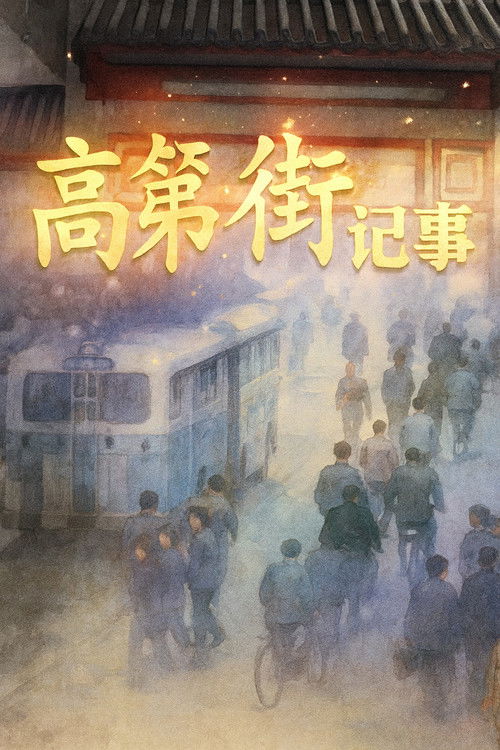
Gaodi Street Chronicle (高第街记事)
Plot Overview
Gaodi Street Chronicle follows the intertwined lives of Lin Jiazhen and Mai Zhiwei, two childhood friends from Gaodi Street in Guangzhou. After spending their youth as sent-down youths (educated youth) in the countryside during the Down to the Villages movement, they return to their hometown at the beginning of the 1980s. Upon their return, they reunite with their old friend Hu Xihao, and the three young people begin to navigate the rapidly changing world of Guangzhou at the start of China‘s Reform and Opening-Up. As individual economic activity—or private enterprise—starts to take hold across China, Jiazhen, Zhiwei, and Xihao seize the opportunity. They begin by selling second-hand electronics and setting up market stalls, trying to build a better life for themselves. Their plans, however, are met with skepticism from their traditional families—Jiazhen’s mother He Xiuqun, as well as Zhiwei’s parents Mai Jinquan and Li Yu‘e—who view this new kind of commerce with deep distrust. More organized opposition comes from the conservative housing bureau chief Dai Gaobao and his wife Yu Yuzhu, who try to stop the young entrepreneurs, branding their activities as illegal speculation. In the face of resistance from both family and authority, the three protagonists struggle to survive and flourish. Gradually, the influx of new consumer goods brought by private trade begins to improve the lives of Gaodi Street’s residents. The community‘s mindset begins to change as they see the tangible benefits of the reforms. With the encouragement of new government policies, Lin Jiazhen and Mai Zhiwei overcome the obstacles in their path, eventually growing into two of the first successful private entrepreneurs in Guangzhou, and then nationwide. Their shared journey culminates in their marriage, symbolizing the union of personal and professional success within the new era. Throughout the process, the people of Gaodi Street follow the rhythm of the times and each finds a new life for themselves. Gaodi Street Chronicle is a “Southern-flavor TV drama” that vividly captures the distinctive Lingnan regional culture and the entrepreneurial spirit of Guangzhou at the beginning of China’s economic transformation.
Main Cast



Deep Dive: Story Arcs & Episode Guide
Arc 1: From Sent-Down Youth to Entrepreneurship (Seasons 1–2) Core Conflict: Jiazhen, Zhiwei, and Xihao return to Guangzhou from the countryside and find a city beginning to open up. The central struggle is whether the three young people will cling to the safety of traditional state-assigned jobs or take the risk of venturing into the uncharted waters of private enterprise as individual economic activity emerges. Progression:
- The trio returns to Gaodi Street and starts planning their futures. Witnessing the early reforms, they decide to set up stalls and sell goods—initially second-hand appliances and other daily necessities.
- Their entrepreneurial zeal is met with immediate pushback. Their families hold deep suspicions about “private business,” worried that it is unreliable or even dangerous. A more significant threat comes from the conservative authorities, especially Dai Gaobao and his wife, who view their small-scale trading as the illegal act of speculation and attempt to shut them down.
- Despite these obstacles, Jiazhen and Zhiwei persevere. The quality of life in Gaodi Street begins to improve as new products and fresh opportunities flow into the neighborhood, changing public opinion in favor of the reforms. Their individual success is legitimized as new government policies support the private economy.
- The arc reaches its natural conclusion with the triumph of the entrepreneurial spirit: Jiazhen and Zhiwei become two of the first successful private merchants in Guangzhou and in the country, and they solidify their personal bond by getting married.
Arc 2: A Community in Transformation (Seasons 2–3) Core Conflict: With the success of Jiazhen and Zhiwei as a benchmark, the focus expands from three individuals to the entire community of Gaodi Street. The central question becomes: in a rapidly changing environment, how does each person and each family find their own path within the new market economy? Progression:
- The second season sees Jiazhen’s family expand their breakfast stall into a thriving eatery. Zhiwei deepens his electrical appliance business and secures a permanent job position, achieving a stable foothold. Xihao opens a clothing store, marking the beginning of his own entrepreneurial journey, although later market saturation in electronics and watches will cause him to suffer heavy losses. Mai Zhiwei‘s sister, Mai Zhiling, develops an interest in the arts. Meanwhile, even the conservative Dai Gaobao’s daughter, Dai Xianghong, begins to reject her parents’ overprotection and seeks approval from her more open-minded peers.
- In the third season, the story shifts to the broader commercial flowering of Gaodi Street. The sign for the “Gaodi Street Industrial Products Market” is officially hung on the street‘s archway, symbolizing its formal designation as a commercial hub. As Gaodi Street grows, Jiazhen moves from selling meals into the clothing trade. Jiazhen’s brother, Lin Jiajie, takes the national college entrance examination (Gaokao). The conservative Dai Gaobao and his wife, Yu Yuzhu, struggle to adapt and adopt a resistant attitude toward the new era. In contrast, another resident, Zhu Gaozheng, forms a pop band, representing the cultural vibrancy that accompanies the economic boom.
- The arc culminates in a sense of community-wide renewal. Despite the risks of the market (Xihao‘s financial losses) and lingering conservative resistance (Dai Gaobao’s stance), the overall trajectory is one of shared progress. Each person, in their own way, keeps pace with the era and finds a new life, showcasing the collective transformation of an entire Guangzhou community during the 1980s.
Arc 3: Connecting Gaodi Street to the Wider World Core Conflict: As the reforms deepen in later seasons, the characters are forced to look beyond their street and city. The arc centers on how the community’s increasing economic and social connections to Hong Kong and the broader global economy bring both new opportunities and personal upheavals. Progression:
- A key subplot involves Pan Jieping (潘洁萍), who is granted permission for a single-trip family visit to Hong Kong. Her journey represents the personal reunions and diaspora connections that became possible in the 1980s and reflects the strong Cantonese cultural ties to Hong Kong.
- This connection is reciprocated when Pan Disheng (潘迪笙), likely a relative from Hong Kong, returns to Guangzhou to visit her family in Gaodi Street. The “Hong Kong connection” brings not only emotional reunions but also material changes—as seen when Jiu Jiu (Uncle Jiu) opens a shop called “Hong Kong House” on the street, introducing Hong Kong-style products and aesthetics to the neighborhood.
- The arc concludes by affirming that Gaodi Street is no longer an isolated lane but a node in a larger network of commercial and cultural exchange. It highlights the personal stories of separation and reunion that defined the era, while demonstrating how the spirit of Gaodi Street—resilience, community, and a willingness to embrace change—allows its residents to thrive as they connect with the outside world.
If this page helped you find your favorite actor or drama details, consider supporting the site.
Support me on Ko-fi